Made-to-order (MTO) upholstery gives buyers control over the details that determine whether a sofa works in practice – its dimensions, configuration, covering and relationship with the room. For Chesterfields Direct, that approach is central to a Lancashire furniture business producing leather seating across traditional, high-back and vintage-look designs …
The company was founded in Rochdale in 1980. In 2025, it moved to a larger workshop in Blackburn, retaining the same team while creating more space for production. Its furniture continues to be made to order, allowing customers to choose the leather, colour and configuration rather than simply selecting from finished stock.
From hardwood frame to finished upholstery
Construction begins with a solid, seasoned, kiln-dried hardwood frame. The joints are secured using glue, screws and dowels, providing a substantial structure beneath the upholstery. Foams and fibres then vary according to the design, reflecting differences in seat profile, cushioning and intended appearance.
Upholstery is completed by hand. One craftsperson takes responsibility for the upholstery process from start to finish, maintaining continuity through that stage of production. Deep buttoning and studding are also applied by hand, both of which require consistent spacing and tension if the finished lines are to remain balanced across the back, arms and border.
This method is particularly relevant to Chesterfield-style furniture. Rolled arms, buttoned surfaces and shaped front borders leave little room for imprecise alignment. They also make the relationship between frame dimensions and upholstery more visible than it might be on a loose-covered sofa.
Traditional proportions – the Cambridge
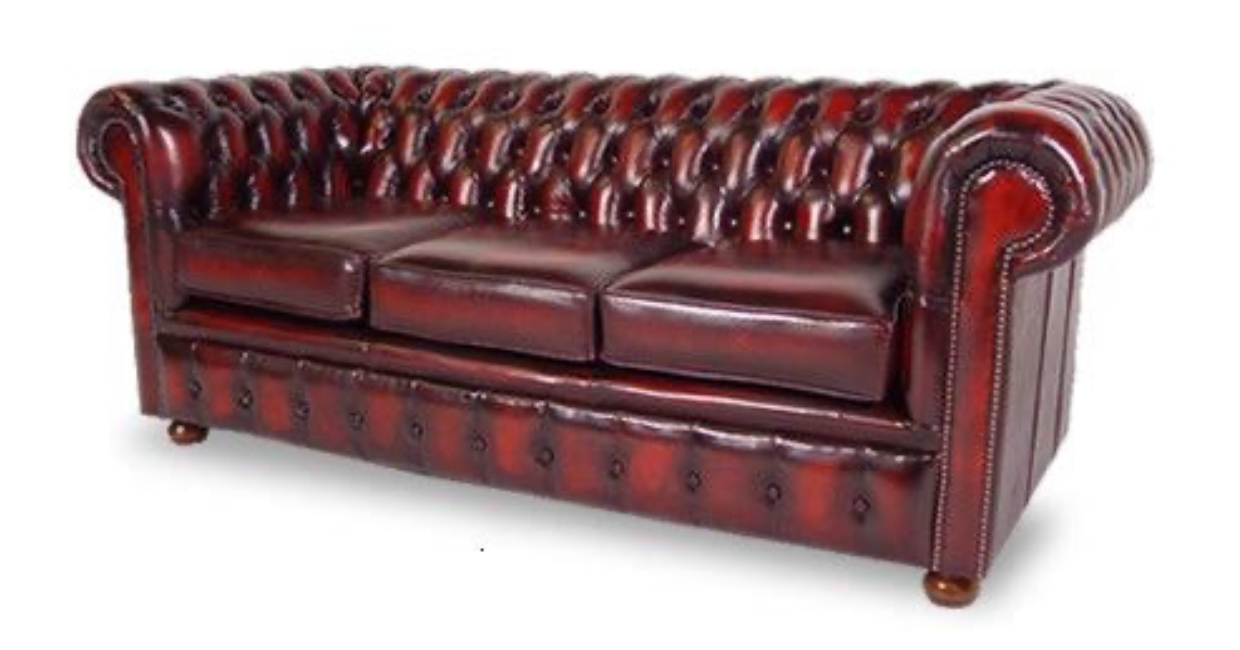
The Cambridge (pictured) demonstrates the company’s more traditional design language. It combines rolled arms, a low back and deep buttoning, and is offered in two-, three- and four-seat versions.
Its low, continuous line can suit rooms where a tall sofa would interrupt sightlines, but the rolled arms need to be included carefully in space planning. External width is not the same as usable seating width – substantial arms occupy part of the footprint. Buyers should therefore compare the overall measurements with the internal seat dimensions rather than relying on the nominal number of seats.
The choice between two, three and four seats should also account for surrounding furniture. A larger model may fit against a wall but still leave insufficient clearance around side tables, door swings or a central coffee table.
A vintage silhouette with raised legs
The Vintage Chesterfield model changes the proportions while retaining recognisable buttoned detailing. It has wide, swooping arms, a fixed buttoned seat and 6in legs. The range includes two-, three- and four-seat sofas as well as a club chair.
Raised legs give the design more visible space beneath the frame, while the sweeping arms create a broader outline. That combination can make the model feel visually lighter at floor level without reducing its overall presence. Again, buyers need to consider the widest point of the arms when checking alcoves, chimney breasts and delivery routes.
The company’s collection of vintage Chesterfield sofas consists of newly made furniture designed to provide an aged appearance. The distinction matters – 'vintage' describes the visual character of the finish and silhouette, not the age or provenance of the individual piece.
Choosing the leather finish
Chesterfields Direct offers more than 50 leather colours across four principal ranges – Traditional Antique, Windsor, Old English and Premium Vintage. Each creates a different surface character, so colour should not be considered separately from finish.
Traditional Antique leather uses a contrasting topcoat that is partially removed, revealing the base colour beneath and accentuating areas such as buttoning and edges. Windsor offers more uniform solid colours with an embossed grain, making it appropriate where a more consistent appearance is preferred.
Old English is a semi-aniline leather with a pull-up effect and visible natural markings. Its tonal movement is part of the material’s appearance rather than an indication of complete uniformity. Premium Vintage uses new leather finished to produce a distressed, cracked look for buyers seeking more pronounced aged character.
Free samples provide a more reliable basis for selection than a screen. Leather colours and surface effects can appear different under daylight, warm evening lamps and cooler overhead lighting. Samples should be placed in the intended room and viewed at several times of day, ideally alongside flooring, curtains and painted finishes.
Tailoring size and configuration
Alongside standard models, the company accepts bespoke enquiries covering adjusted dimensions and configurations. A productive brief needs more than a request to make a sofa 'slightly smaller'. Customers should provide a dimensioned room plan, the maximum permitted width and depth, and any restrictions affecting delivery.
Door widths, hallway turns, stair angles and lift dimensions all matter. So do architectural features inside the room, including radiators, sockets, windowsills and skirting boards. For a sofabed, the open depth must be checked as well as the closed footprint.
The Durham sofabed, for example, incorporates a concealed three-fold pull-out mechanism within a design featuring a deep-buttoned back and arms and a double-buttoned front border. It offers occasional guest accommodation without abandoning the visual language of the wider range, but still requires sufficient floor clearance when opened.
A practical specification
The broader Chesterfields Direct range covers straight sofas, chairs, suites, sofabeds, high-back models and vintage-look furniture. That breadth allows buyers to co-ordinate several pieces or concentrate on one model tailored to a particular room.
Before ordering, the clearest approach is to send the manufacturer a dimensioned plan, identify the preferred model and configuration, and compare physical leather samples in the space. The final written specification should record external dimensions, covering, colour and any agreed alterations. For MTO upholstery, that preparation is what turns a design preference into furniture properly considered for its setting.
Pictured: Cambridge sofa in antique oxblood leather, Chesterfields Direct